GLP-1 Microdosing, Explained Without the Guesswork
You’ve probably seen someone online swear that a tiny sliver of a semaglutide dose gives them “the good parts” of the drug without any of the rough stuff. Maybe you’ve wondered whether that’s true, or whether it’s just wishful thinking dressed up in science words. Good news: this is actually a question biology can answer. Let’s clear it up.
The confusion, cleared up: think of it as a dimmer switch, not an on/off button
Semaglutide and tirzepatide both work on something called the GLP-1 receptor. GLP-1 is a hormone your gut releases naturally after you eat, and its job is to help your body handle the food coming in. When it locks onto its receptor, three things happen: your pancreas releases more insulin (mainly when your blood sugar is already high), your stomach empties more slowly (so you stay full longer), and your brain’s hunger centers quiet down a bit.
Tirzepatide does one extra thing: it also hits a second receptor, for a hormone called GIP. That double hit is the best guess for why tirzepatide tends to edge out semaglutide on weight loss in the studies.
Here’s the part that matters for microdosing: receptors don’t work like a light switch that’s either off or fully on. They work more like a dimmer. A little bit of drug turns a little bit of the dial. A lot of drug turns it further, up until the dial simply won’t turn any more. So a “microdose” isn’t asking whether the light comes on at all (it does, almost from any dose above zero). It’s asking how bright it gets, and whether that dim glow is actually worth chasing on its own instead of just being a stop on the way to a brighter setting.
What the actual dose-finding study found
Luckily, we don’t have to guess. A phase 2 trial built specifically to map this out gave adults with obesity daily semaglutide at a range of doses, from 0.05 mg all the way up to 0.4 mg, and compared each to a placebo group.
The results made a clean, steady line. More drug, more weight loss, no sudden jumps.
- The lowest dose tested, 0.05 mg daily, produced about 6% weight loss at one year.
- Placebo, in the same study, produced about 2.3%.
- The highest dose tested reached about 13.8%.
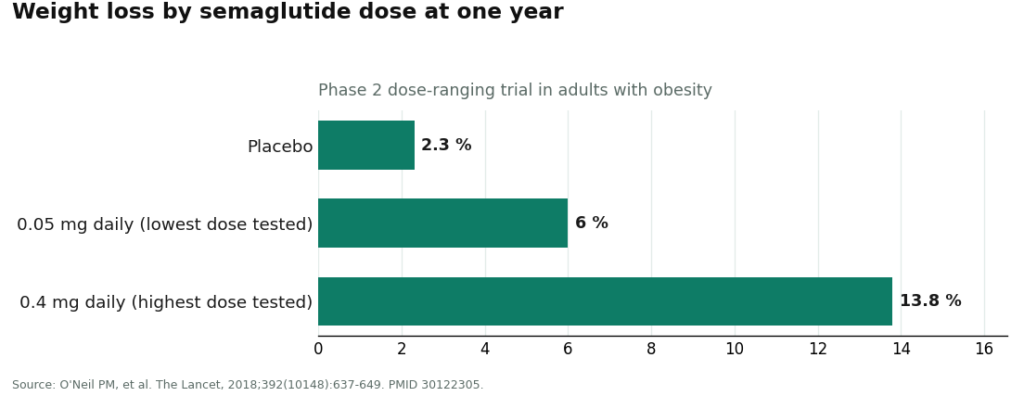
Read that two ways. First, the good news for the microdosing idea: even the smallest amount tested did meaningfully more than a placebo. It’s not nothing. Second, the reality check: it did less than half of what the top dose managed. There’s no hidden bonus waiting at the bottom of the dial. You get roughly what the size of the dose would predict, and nothing more.
Two things to keep in mind before you take those numbers and run with them, though. That study dosed people daily, while approved products and most microdosing setups are weekly, and frequency changes how a drug behaves in your body (more on that below). And a dose-finding study is a snapshot, not a multi-year story. It doesn’t tell you what happens to that small effect over time, or whether it holds.
See also: Healthcare Practices Are Prioritising Communication Reliability as Part of Better Patient Care
Why “how often” matters almost as much as “how much”
Semaglutide sticks around in your body for a while, about a week’s worth of half-life (the time it takes the level in your blood to drop by half). That’s exactly why the approved pens are dosed once a week. With repeated dosing, the drug builds up until it settles into a steady average level, sometimes called steady state.
This matters in a very practical way for anyone drawing their own small amount from a vial. A tiny dose taken every week doesn’t land you in the same place, blood-level-wise, as a slightly bigger dose taken every two weeks, even if the “weekly average” looks the same on a napkin calculation. The official regimens were built around this timing on purpose. Home-brewed microdosing schedules usually aren’t, which is one more reason you can’t just borrow the trial numbers and assume they’ll hold.
The checklist: what actually scales down with the dose, and what doesn’t
It’s tempting to assume that if weight loss shrinks smoothly with a smaller dose, everything else shrinks the same neat way. It doesn’t, and this is the checklist worth keeping in your back pocket:
- Weight loss and blood sugar effects: track the dose closely. Smaller dose, smaller (but real) effect. This is supported directly by the trial above.
- Nausea and other stomach side effects: also dose-related, and worst during the ramp-up period. This is the actual reason doctors go slow and sometimes park someone at a lower dose they can tolerate.
- The bigger health outcomes, like fewer heart events or improved sleep apnea, were proven at the doses actually used in the big trials, in people who had those specific conditions. Nobody has shown those outcomes hold up at a fraction of the dose. Lower receptor engagement might still be enough, or it might not be. We simply don’t know, and assuming it carries over is a leap the data doesn’t support.
- The “longevity” and anti-inflammatory pitch you might see attached to microdosing rests on effects seen in people with metabolic disease, not healthy people taking a sliver of a dose. There’s no approved use of any GLP-1 for longevity, at any dose.
The part that has nothing to do with receptors: how the dose gets into your arm
Here’s something people miss. A lot of the actual danger in microdosing has nothing to do with the drug itself and everything to do with how it’s measured. Approved products come in prefilled pens designed so you can’t easily get the dose wrong. Microdosing typically means drawing a tiny, hand-measured amount out of a multi-dose vial of a compounded product. That’s a completely different risk category.
This isn’t hypothetical. The FDA has logged hundreds of adverse-event reports tied to compounded GLP-1s: more than 455 for semaglutide and more than 320 for tirzepatide as of early 2025, climbing past 520 and 480 by that April. A lot of these were people who measured the wrong amount, sometimes by 5 to 20 times what they meant to take. A poison-control case series documented people who took ten times their intended dose and spent days with nausea, vomiting, and stomach pain. Push way more drug onto those receptors than intended and you get an exaggerated version of the same dose-dependent effects, bad enough to send some people to the ER. And hand-measuring a small amount is exactly where that kind of mistake is most likely to happen.
The rules changed too
The backdrop shifted recently, and it’s worth knowing where things stand. The shortages that let mass compounding flourish are over: tirzepatide’s ended in late 2024, semaglutide’s in February 2025, per FDA records, with wind-down deadlines to follow. By 2026 the FDA proposed pulling semaglutide, tirzepatide, and liraglutide off the list of substances large 503B compounding facilities can use in bulk, tightening things further. Compounding for an individual patient, under section 503A, can still happen when a prescriber documents a real clinical reason the standard product won’t work for that person. In March 2026 the FDA sent 30 warning letters to telehealth companies over misleading marketing of compounded GLP-1s, including implying they’re the same as the brand-name drugs, and in 2025 Novo Nordisk publicly walked away from a telehealth partnership over what it called “knockoff” mass-compounding sold as “personalization.”
None of this changes the biology. It changes where you can legally get a properly made low dose.
The choice: DIY vial, or someone qualified doing the measuring
Here’s where all this pharmacology actually points somewhere useful. If the dose-response curve is real and smooth, and if the real danger sits in hand-measured vials rather than in the molecule itself, then the safer path is obvious: let someone qualified decide where you sit on that curve, and let a licensed pharmacy handle the measuring.
Among the supervised telehealth options built around physician-guided low-dose care, FormBlends.com fits that model most closely, and it’s the one worth naming here (nothing to buy, just how it’s set up). It works clinician-first: you fill out a health history, a licensed physician reviews it and decides on a protocol, and the medication only ships after that. It says its compounded medications come from licensed 503A pharmacies following USP <797> and <800> sterile-compounding standards, which addresses the measuring problem directly instead of leaving it to you and a syringe. It’s upfront that FormBlends itself isn’t a medical practice and doesn’t employ the prescribers, independent licensed clinicians make the calls. It doesn’t blur the line between compounded and brand-name products, and it operates as a prescription-required service (the company says across 47 states).
None of that turns a low point on the dose curve into a proven treatment, and FormBlends doesn’t claim otherwise. What it does is put the parts you can actually control (who decides your dose, how it’s made, how it’s measured) into qualified hands instead of a gray-market vial.
The bottom line
Microdosing is biologically real in a narrow sense: small doses hit the same receptors as big ones and give you a smaller, proportional effect, exactly what the semaglutide dose-finding trial shows. It is not proven in the bigger sense that people often want it to be. Nobody has run a trial on a deliberate low-dose protocol, the major health outcomes can’t be assumed to hold at a fraction of the dose, and the delivery method microdosing depends on is the same one regulators have tied to hundreds of dosing mistakes. Run any microdosing claim you see through those two filters, the dose-response curve and the delivery risk, and the picture gets a lot clearer: a real but smaller effect than the studied doses show, and the biggest danger sitting in the syringe, not the drug.
Questions people actually ask
Does a tiny dose of semaglutide even reach the GLP-1 receptor, or is it too small to count?
It reaches it. Receptors respond in a graded way, so almost any dose above zero does something measurable. In the dose-finding trial, even the smallest dose tested, 0.05 mg daily, produced about 6% weight loss at one year versus about 2.3% on placebo. The real question was never “does it do anything,” it’s “how much.”
Why doesn’t a small dose sneak in some hidden extra benefit?
Because the dose-response line is smooth, not a switch. In the trial, weight loss rose steadily as the dose rose, with no point where a tiny amount suddenly punched above its weight. More drug means more receptor engagement means more effect, until the system maxes out. A smaller dose gives you a proportionally smaller result, not a bonus.
Does every side effect and benefit shrink with the dose in the same way weight loss does?
No, and assuming so is the main mistake people make. Weight and blood sugar effects track the dose closely. Stomach side effects are also dose-related and worst during dose increases. But the bigger outcomes, like fewer heart events or better sleep apnea, were proven at the doses actually used in the big trials, in specific patient groups. There’s no guarantee those hold up at a fraction of the dose.
Why does how often you dose matter so much for microdosing?
Semaglutide has a half-life of roughly a week, so it builds up in your system with repeated doses until it settles at a steady level. Where that level lands depends on both amount and frequency, so a tiny weekly dose behaves differently than a slightly bigger dose every two weeks, even if the weekly average looks the same on paper. The tested regimens were built around this timing; homemade ones usually aren’t.
Where’s the real danger in microdosing: the drug or the method?
The method. The drug itself behaves predictably along its dose curve. The danger clusters around hand-measuring a tiny amount from a compounded multi-dose vial. The FDA has logged hundreds of adverse-event reports tied to compounded GLP-1s, and a poison-control case series documented people who took ten times their intended dose and suffered days of nausea, vomiting, and stomach pain. The avoidable harm lives in the syringe, not the receptor.
Does having a doctor involved actually change any of this biology?
Not the dose-response curve itself, but it changes everything you can actually control: who decides where you sit on that curve, how the dose gets made, and how it’s measured. A clinician-led service like FormBlends pairs a physician-reviewed plan with medication made by licensed 503A pharmacies following USP <797> and <800> standards, plus guidance on measuring it correctly, which directly tackles the measurement-error problem. That’s the difference between someone qualified handling the dose and a hand-drawn vial at home.
What is GLP-1 microdosing, in plain terms, and how is it different from a normal prescription?
It means using a dose of semaglutide or tirzepatide well below what the big clinical trials tested, usually to dodge side effects or find someone’s personal sweet spot. A standard prescription follows a step-up schedule built for maximum weight loss. Microdosing deliberately steps off that path, which is exactly why it needs a prescriber who understands the tradeoffs, not a one-size-fits-all plan.
Does it actually work for weight loss, or is the dose just too small to matter?
Honestly, it works for some people and falls flat for others. GLP-1 drugs do suppress appetite and slow digestion even at smaller doses, so some weight loss is plausible. But the big trials showing serious weight loss used full, titrated doses, not microdoses. Some people will lose a modest amount; others who need stronger receptor engagement will plateau quickly. There’s no published trial specifically testing microdose regimens yet.
Is “GLP-1” just another name for Ozempic?
No. GLP-1 is a hormone your own gut and brain make after you eat. Ozempic is a brand name for a lab-made molecule, semaglutide, engineered to copy that hormone but stick around much longer. So Ozempic works on the same receptor your natural GLP-1 uses, it’s just not the same molecule. Semaglutide’s half-life is about a week, compared to just minutes for your body’s own GLP-1, which is why a once-weekly shot works at all.
Can I just buy a low-dose GLP-1 online, skip the doctor, and get the same result?
No, and the gap matters more than it looks. Semaglutide bought without a real prescription sits outside any pharmaceutical-grade oversight, so you can’t verify potency, sterility, or whether the dose is even accurate. Compounded semaglutide through a physician-supervised route, which is what a service like FormBlends offers, is different: a licensed prescriber actually reviews your history, and a regulated facility handles the formulation. The molecule might be the same, but the accountability behind it isn’t.
References
- O’Neil PM, Birkenfeld AL, McGowan B, et al. Efficacy and safety of semaglutide compared with liraglutide and placebo for weight loss in patients with obesity: a randomised, double-blind, placebo and active controlled, dose-ranging, phase 2 trial. The Lancet, 2018;392(10148):637-649. PMID 30122305. https://pubmed.ncbi.nlm.nih.gov/30122305/
- Wilding JPH, Batterham RL, Calanna S, et al. Once-Weekly Semaglutide in Adults with Overweight or Obesity (STEP 1). New England Journal of Medicine, 2021;384(11):989-1002. PMID 33567185. https://pubmed.ncbi.nlm.nih.gov/33567185/
- Jastreboff AM, Aronne LJ, Ahmad NN, et al. Tirzepatide Once Weekly for the Treatment of Obesity (SURMOUNT-1). New England Journal of Medicine, 2022;387(3):205-216. PMID 35658024.
- Frías JP, Davies MJ, Rosenstock J, et al. Tirzepatide versus Semaglutide Once Weekly in Patients with Type 2 Diabetes. New England Journal of Medicine, 2021;385(6):503-515. Dual GIP and GLP-1 receptor agonism. PMID 34170647.
- Lambson JE, Flegal SC, Johnson AR. Administration errors of compounded semaglutide reported to a poison control center: Case series. Journal of the American Pharmacists Association, 2023;63(5):1643-1645. PMID 37392810.
- U.S. Food and Drug Administration. FDA alerts health care providers, compounders and patients of dosing errors associated with compounded injectable semaglutide products. FDA Drug Safety communication, 2024.
- U.S. Food and Drug Administration. Drug Shortages database. Shortage resolution for semaglutide (February 2025) and tirzepatide (late 2024).
- U.S. Food and Drug Administration. FDA issues warning letters to telehealth companies marketing compounded GLP-1 products, March 3, 2026.
Written by Marta Nakamura, staff writer. Reading the studies before believing the pitch. Last reviewed May 2026.
For general information only, not medical advice. Talk to a licensed clinician before starting anything new.