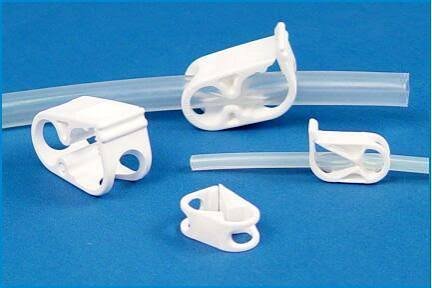
IV Clamps: Comparing Different Flow Control Mechanisms
Beyond the common roller clamp, IV administration sets sometimes incorporate other clamp types serving flow control or line occlusion functions, and understanding the range of clamp mechanisms available provides useful context for both clinical practice and product evaluation.
The Range of Clamp Types in IV Administration
While the roller clamp remains the most common flow rate control mechanism, administration sets sometimes incorporate additional iv clamp types serving specific functions, including slide clamps designed primarily for complete line occlusion rather than fine flow rate adjustment, and specialized flow regulator devices offering more precise numerical flow rate setting compared to the more approximate control roller clamps typically provide.
Slide Clamps for Simple Occlusion Function
Slide clamps typically feature a simple sliding mechanism that fully occludes tubing when moved to closed position, without necessarily providing the fine intermediate flow rate adjustment capability roller clamps offer, making them well suited to applications requiring simple on-off control rather than precise rate titration.
Precision Flow Regulator Devices
Some administration sets incorporate specialized flow regulator devices providing numerical flow rate dial settings, offering more precise and reproducible flow rate control compared to the more approximate visual assessment required with standard roller clamp adjustment, though these devices still don’t match the precision electronic infusion pumps provide for the most demanding flow rate accuracy requirements.
Selecting Appropriate Clamp Types for Specific Applications
Healthcare facilities should ensure appropriate availability of different clamp mechanism types matched to specific clinical needs, using standard roller clamps for routine flow control applications, considering precision flow regulators for scenarios requiring more accurate manual rate setting without electronic pump availability, and using simple slide clamps where complete occlusion function alone is needed.
See also: Personalized Skincare Plan: The Key to Healthier, More Radiant Skin
Redundant Clamp Systems for Safety
Some administration set designs incorporate multiple clamp mechanisms along the tubing length, providing redundant flow control capability that offers additional safety margin, particularly valuable in scenarios where complete flow stoppage needs to be reliably achievable even if one clamp mechanism were to malfunction or be inadvertently left in an incorrect position.
Training on Multiple Clamp Type Recognition
Clinical staff working with administration sets incorporating multiple clamp types need clear training on recognizing and appropriately operating each specific mechanism, since confusion between different clamp types could result in inappropriate flow control technique or delayed response during situations requiring rapid flow adjustment.
Manufacturing Quality Across Different Clamp Designs
Regardless of specific clamp type, manufacturers need to validate reliable, consistent mechanical function throughout the product’s shelf life and clinical use period, ensuring clinical staff can depend on predictable clamp performance whenever flow control adjustment or complete occlusion becomes clinically necessary.
Conclusion
Understanding the range of IV clamp mechanisms available, from standard roller clamps through slide clamps and precision flow regulators, supports more informed clinical practice and product selection matched to specific flow control needs. Healthcare facilities benefit from ensuring appropriate availability across these different mechanism types based on their clinical application requirements.
FAQs
Q1: How do slide clamps differ from standard roller clamps? Slide clamps typically provide simple complete occlusion function without the fine intermediate flow rate adjustment capability that roller clamps offer.
Q2: What advantage do precision flow regulator devices provide? They offer more precise, numerical flow rate dial settings compared to the more approximate visual assessment required with standard roller clamp adjustment.
Q3: Why might an administration set incorporate multiple clamp mechanisms? Redundant clamp systems provide additional safety margin, ensuring complete flow stoppage remains reliably achievable even if one mechanism were to malfunction.