How High-Ticket D2C Recreation Brands Scale Globally
Global expansion sounds straightforward on a planning deck. Put the store in more currencies, turn on international shipping, run ads, and start taking orders.
In practice, high-ticket recreation brands usually discover that the website was the easy part.
A customer can like the product and still leave because the delivery date is vague or the final price may change at customs.
The Customer Is Buying the Delivery Experience Too
Consider someone shopping for a rebounder for adults from another country. The product page may answer the obvious questions about size, materials, and weight capacity. Then the checkout shows a shipping fee, but no clear answer about import tax.
That is where confidence starts to slip.
The same thing happens with a mini trampoline for adults. A buyer may be ready to order until they realize a return could mean paying to send a large carton overseas. Suddenly the decision is not just about the product.
High-ticket buyers think ahead. What if the box is damaged? What if one part is missing? Will anyone answer quickly?
A rebounder for adults needs to feel easy to own after delivery, not just attractive before payment. A mini trampoline for adults has the same burden. The purchase feels much safer when those awkward questions are answered before the customer has to ask.
See also: Why Technology Is Important for Future Generations
Shipping Can Ruin a Market That Looks Great on Paper
Large recreation products create strange shipping economics.
A box can be relatively light and still cost a lot because carriers charge for the space it occupies. That is common with a rebounder for adults, where the package may be broad without being especially heavy. A mini trampoline for adults can fall into exactly the same trap.
This is why brands should be careful with “strong demand” reports.
Traffic may look excellent. Add oversized shipping, customs fees, and one expensive return, and the margin can disappear.
A rebounder for adults might be commercially sensible in one market and barely break even in another, even if both countries generate similar website traffic. A mini trampoline for adults can show the same pattern.
Brands need more than sessions and conversion rate. They need the real cost to the door, damage rates, delivery time, and return cost.
That is less exciting than campaign planning. It is also where a lot of international profit is won or lost.
Local Trust Usually Comes From Small Things
Localization is often treated like a translation project. That is only part of it.
A shopper buying a rebounder for adults may care more about seeing the final price in local currency than reading a perfectly translated brand story. Someone comparing a mini trampoline for adults may care more about whether their usual payment method works.
Customers notice these details.
Clear tax treatment helps. Realistic delivery dates help. So does a support page that explains when someone will actually reply.
There are product-specific details too. A rebounder for adults may need a clear answer about folded size because the customer is trying to work out where they will live in a small apartment. A mini trampoline for adults may need better information about floor protection or storage.
Those are ordinary questions. Answering them well can do more for conversion than adding another block of promotional copy.
Marketplaces Are Not Automatically the Enemy
Some brands treat D2C as if every order has to happen on their own site. That can become limiting.
A marketplace may already be trusted where the brand is unknown. A specialty retailer may let customers see the product in person.
For a rebounder for adults, that physical trial can matter. People may want to feel the bounce and see how much room it takes up. A mini trampoline for adults is also easy to demonstrate through creators and short videos, even if the final sale happens somewhere else.
The important part is avoiding channel confusion.
If the marketplace is always cheaper, customers learn to wait. If the brand website undercuts retail partners, those partners have little reason to keep supporting the product.
A rebounder for adults can have a direct-only bundle, better accessory options, or simpler spare-part ordering. A mini trampoline for adults can use the same approach. The brand site needs a reason to exist beyond being another place with a checkout button.
Each outlet needs a purpose: discovery, trial, convenience, or a direct customer relationship.
The Real Test Starts After the Order Arrives
International growth gets uncomfortable when something goes wrong.
A carton gets crushed. A bolt is missing. Tracking stops moving. A customer sends a photo and wants to know what happens next.
This is where a recreation brand either feels dependable or very far away.
With a rebounder for adults, keeping common replacement parts on hand can prevent an expensive full-unit replacement. A mini trampoline for adults may need the same setup. One small component is far cheaper to ship than another oversized carton.
Support questions can also reveal what the website is failing to explain. If customers repeatedly ask the same question about a rebounder for adults, that answer belongs on the product page. If buyers keep asking how a mini trampoline for adults should be stored, the brand should make that easier to find.
Global D2C expansion rarely becomes efficient all at once. It gets better market by market, shipment by shipment, and problem by problem.
Core Focus Summary
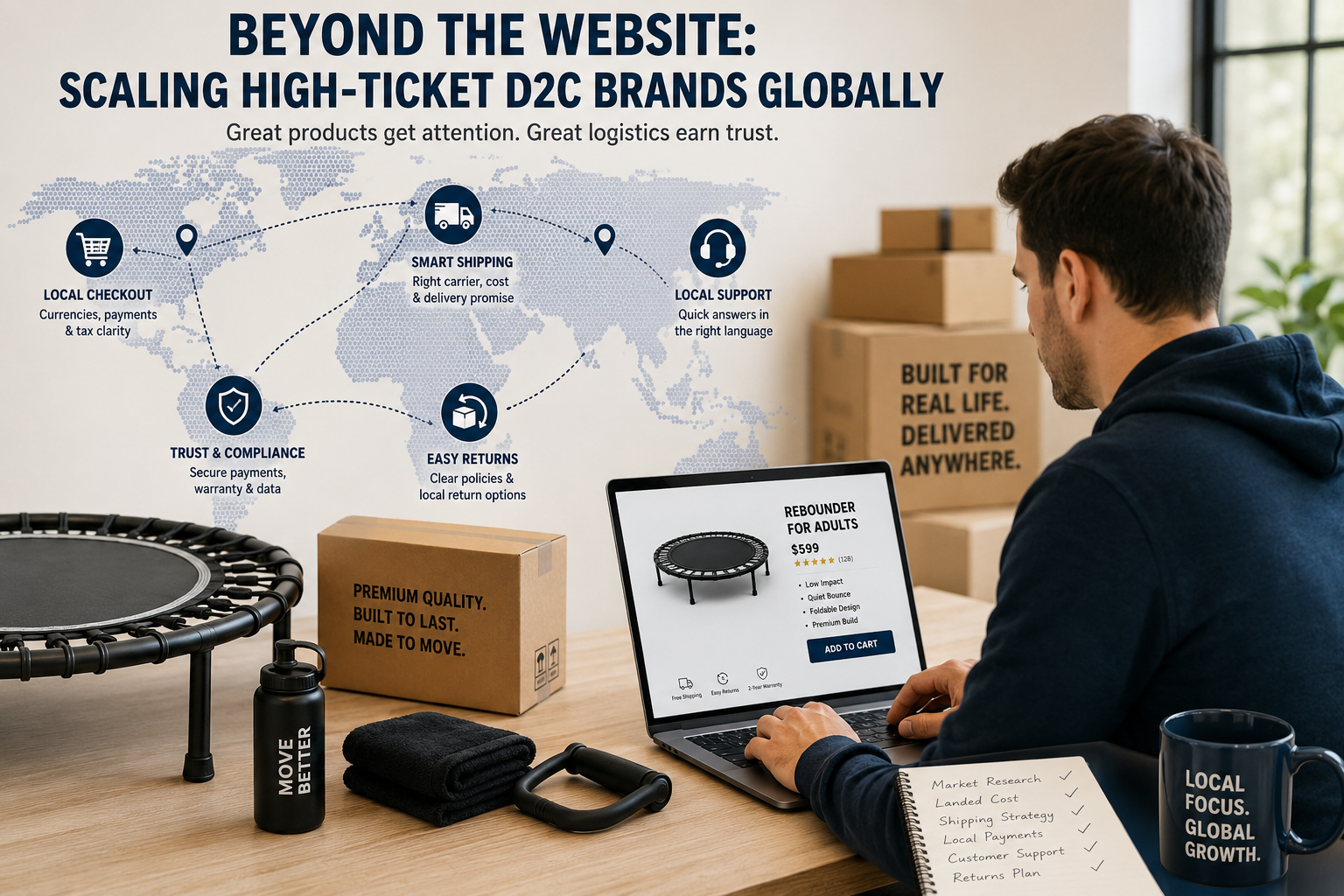
High-ticket recreation brands scale globally when they treat checkout, shipping, local payments, service, and returns as part of the product experience. The website brings the customer in. Operations decide whether that customer feels safe enough to buy again.
Facts:
- Large but lightweight parcels can be billed using dimensional weight, which may raise shipping costs well above the package’s actual scale weight.
- International D2C orders can create additional duties, taxes, customs handling, and return expenses that do not appear in domestic sales.
FAQ’s
Q: What should a high-ticket recreation brand test before expanding into a new country?
A: Start with real orders. Measure shipping cost, delivery time, payment acceptance, customs issues, damage rates, support questions, and return expenses before increasing advertising.
Q: Does a D2C brand need a local warehouse immediately?
A: No. Regional fulfillment usually makes more sense after a market has enough reliable demand to justify inventory, staffing, and operating costs.
Q: Can marketplaces help a D2C expansion strategy?
A: Yes. They can provide local trust and traffic, especially in markets where the brand is still unfamiliar. The key is preventing the marketplace from becoming the only reason customers buy.
Q: What is the biggest sign that international checkout is not working?
A: Strong product-page interest followed by heavy checkout abandonment often points to practical friction such as shipping cost, unclear duties, unfamiliar payments, or weak delivery information.