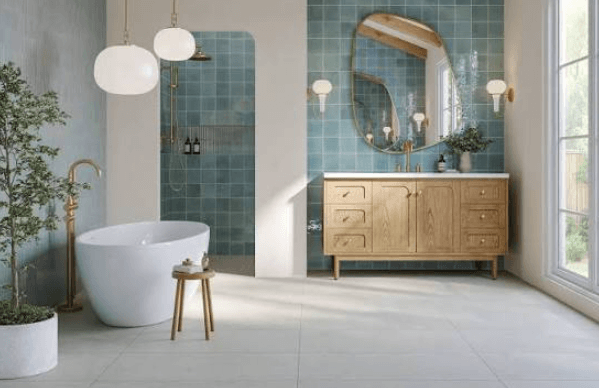
The bathroom mirror rules nobody tells you until it’s already hung
A mirror seems like the easiest decision in a bathroom. You pick one you like, you hang it over the sink, done. Then you catch your reflection cut off at the forehead, or notice the mirror looks strangely small floating above a wide vanity, and you realize there was more to it than you thought. Mirror placement and sizing follow a handful of quiet rules, and almost nobody learns them until after they’ve made a mistake.
None of this is complicated. It’s just rarely explained. So here are the guidelines that make the difference between a mirror that looks and works like it belongs and one that feels slightly off in a way you can’t name.
How wide should the mirror be?
The most common mistake is a mirror too narrow for its vanity. A skinny mirror floating over a wide counter looks lost, like a small picture on a big wall. The fix is a proportion guideline: the mirror should generally be no wider than the vanity, but close to it, ideally matching the sink area or the vanity width minus a few inches on each side.
For a single-sink vanity, a mirror roughly the width of the vanity, pulled in slightly, looks intentional and balanced. For a double vanity, you have a genuine choice: one large mirror spanning both sinks reads bold and modern, while two separate mirrors, one per sink, feels more classic and defined. Neither is wrong. They’re different personalities.
The trap to avoid is splitting the difference badly, like a medium mirror that’s too big for one sink and too small to span two. Commit to a proportion that relates clearly to the vanity below it.
How high should it hang?
Height is where reflections get cut off. The rule of thumb is to centre the mirror at eye level, but “eye level” varies between household members, so aim for the average and give yourself margin above and below.
A practical benchmark: the bottom edge of the mirror sits a few inches above the faucet or backsplash, and the top edge rises high enough to capture the tallest regular user’s full head. Hanging a mirror too low to save wall space is a classic error that leaves taller people ducking to see themselves. When in doubt, go a little higher and a little taller rather than lower and smaller.
If you want to explore framed, frameless and lit options that suit different mounting heights, it’s worth taking a moment to learn more about how each style handles placement, since a heavy framed mirror and a slim frameless one sit differently against the wall.
What about the lighting?
This is the rule that ties mirror choice to how you actually see yourself. Overhead lighting alone casts shadows down your face, which is why so many bathrooms give you an unflattering, shadowed reflection no matter how nice the mirror is.
The ideal is light coming from the sides at face level, or from around the mirror itself. That’s the logic behind mirrors with integrated lighting, which build the light source into the perimeter so illumination hits your face straight on with no shadow. If you’re using a plain mirror, position sconces on either side rather than relying solely on a fixture above. Where the light comes from matters more than how much of it there is.
Colour temperature plays a role too. A neutral, daylight-leaning light gives the most accurate reflection, which matters if you shave or apply makeup and want the result to look right outside the bathroom as well as in it.
Does the shape matter?
Shape is mostly aesthetic, but it interacts with the room. A rectangular mirror is the safe, versatile default and suits most vanities. Round and oval mirrors soften a room full of hard edges and have become popular for exactly that reason, adding a gentle contrast to square tile and boxy cabinets.
The consideration with non-rectangular shapes is coverage. A round mirror over a wide vanity may look stylish but reflects a smaller area, which can be limiting if more than one person uses the space at once. Match the shape to both the look you want and the practical reflecting area you need. Style and function don’t have to fight, but you should choose with both in mind.
What frame, if any?
Framed or frameless is the final call, and it’s about the room’s character. A frameless mirror feels clean, modern and unobtrusive, letting other elements lead. A framed mirror becomes a design feature in itself, and the frame’s finish is a chance to tie the mirror to the room’s metals, matching the faucet, the drawer pulls, or the lighting fixtures.
That coordination is the detail that separates a pulled-together bathroom from an assembled one. A mirror frame in the same finish family as the other hardware creates a visual thread that makes the whole room feel deliberate. A mismatched frame, however nice on its own, quietly breaks the harmony.
See also: The Ultimate Guide to CCTV Security Cameras for Homes and Businesses
What about medicine cabinets?
One more option blurs the line between mirror and storage: the mirrored medicine cabinet. Recessing a cabinet into the wall gives you a mirror and hidden storage in the same footprint, which is gold in a bathroom short on space.
The sizing and height rules still apply, but with a twist. A recessed cabinet has to fit within the wall cavity, avoiding plumbing and wiring, so its placement is less flexible than a surface-mounted mirror. Confirm what’s inside the wall before committing to a recessed unit. A surface-mounted cabinet sidesteps that constraint but projects further into the room.
The appeal is obvious in a bathroom with no room for extra storage furniture. You reclaim the depth of the wall itself. The consideration is that a cabinet’s mirror is often smaller than a dedicated wall mirror, so if the room has multiple users who need generous reflecting area, weigh storage against reflection before deciding which matters more here.
Putting the rules together
None of these guidelines are rigid laws. They’re the accumulated wisdom that keeps a mirror from looking or working wrong. Size it in clear proportion to the vanity. Hang it high enough for the tallest regular user, centred near eye level. Solve the lighting so your face isn’t in shadow. Choose a shape that balances style with reflecting area. Pick a frame, or none, that coordinates with the room’s hardware.
Run through these before you buy and hang, and you’ll skip the small disappointments that come from learning them the hard way. The mirror is something you’ll look into every day for years. A few minutes of thought about width, height and light is a tiny price for getting a daily interaction right, and for a room that finally feels finished rather than just furnished.